

NOVEMBER 2026
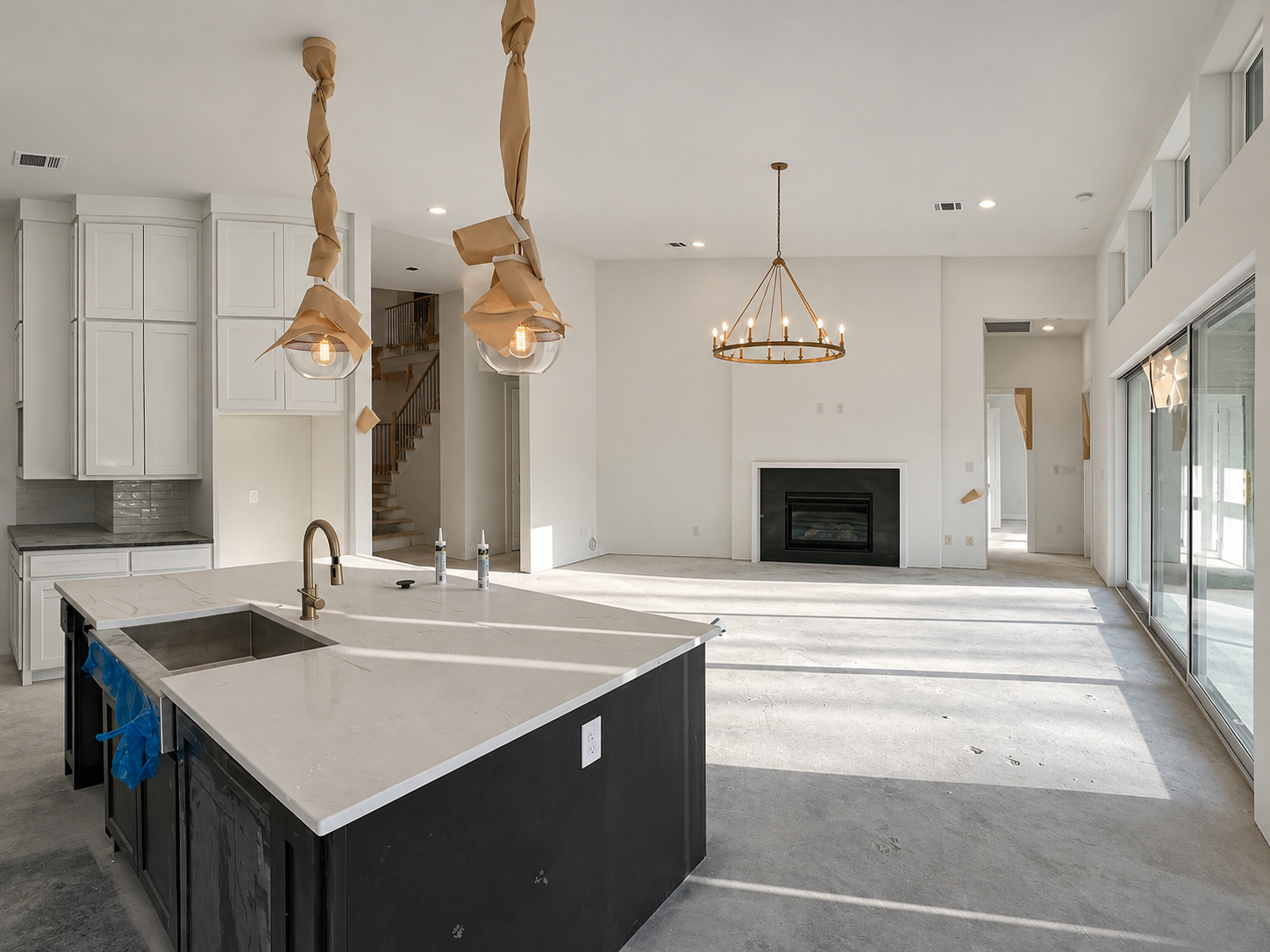
Our house, before anything was in it. The only thing holding your eye here is the light on the floor, and within the hour it had moved.
The first thing people buy for a new house is almost always a sofa.
That is not a criticism. A new house is loud about its empty rooms, and the sofa is the loudest absence in it. But the decisions that determine whether you still love a room in ten years are made before anything is bought, and almost none of them are about furniture.
Here are the five I would make first, in this order. They take an afternoon and a notebook.
One. Decide how you want to feel in the room before you decide how it should look
Style is an answer. Before you can choose one, you need the question, and the question is what the room is actually for.
Not what it is called. What happens in it. Who is in it, at what hour, doing what.
Write one sentence for each room. This is where we read at night and nobody brings a screen. This is where my parents sit when they come for three weeks every winter.
A sentence like that rules out more furniture than a style ever will, and it rules it out for a reason you can still explain to yourself a year later.
Two. Decide where your family will actually end up
New houses are bought partly for the rooms nobody uses. The formal dining room. The sitting room off the entry. There is nothing wrong with wanting them.
But watch your household for a month before you spend money there. Most families collapse into two or three rooms and stay in them. The budget should follow the people, not the floor plan.
A dining room furnished for a holiday you host twice a year is a room you walk past every other day of the year.
Three. Decide what holds your eye
This is the one I spent years on.
My doctoral research at the University of Wisconsin, Madison, asked what people remember about interiors. Sixty-eight people, an eye tracker, and a set of rooms.
What the study measured was a chain. Where attention goes first, then how pleasant the room feels, then what is remembered afterward. The rooms people remembered were not the most expensive ones. They were the rooms that felt good to be in, and the rooms that felt good to be in gave the eye somewhere to settle.
New houses often work against this, for a reason that has nothing to do with taste. They are wide, open, and lit evenly from the ceiling, so attention has nothing to land on and the room reads as a lobby.
So decide, for each room you use, what one thing holds you when you walk in. A window with something alive outside it. One piece of art. The fireplace. Then let everything else in that room be quieter than the thing you chose.
Four. Decide how each room is lit at three times of day
Most new houses arrive with recessed lights on a single switch. That is one kind of light, from one direction, at every hour.
Before you buy furniture, decide how each room should feel in the morning, in late afternoon, and after dark. Then put something at eye level and something low in every room you use at night.
A lamp on a table changes how a room feels more than almost anything you can hang on a wall. This is the cheapest of the five decisions, and the fastest.
Five. Decide what you are not going to furnish yet
An empty room is better than a wrong room.
A wrong room costs you twice, once to buy it and once to live with it, and furniture you regret tends to stay for years because replacing it feels wasteful.
Do the two rooms your family actually lives in, and do them properly. Leave the rest. You will know more about your house in six months than you do in the week you move in, and the rooms will tell you what they need if you let them sit.
These five decisions are yours. They are better made by the people who will actually live in the house than by anyone they could hire.
What I am for is the part afterward. The specific chair and the exact height. The order things are bought in, so nothing arrives before the floors go down. The drawing a contractor can build from without calling you with questions.
But the five decisions come first.
If you are standing in a house full of empty rooms and do not know where to begin, begin with the first one. It costs nothing, and it changes every decision after it.
And if this is the conversation you want to have about your house, begin one here.
This reflection is part of the SoulSpace Journal, a space for design thinking shaped by research and lived experience.
Mirkia, H., Nelson, M. S. C., Abercrombie, H. C., Thorleifsdottir, K., Sangari, A., & Assadi, A. (2022). Recognition Memory for Interior Spaces with Biomorphic or Non-Biomorphic Interior Architectural Elements. Journal of Interior Design, 47(3), 47-66. https://doi.org/10.1111/joid.12224