

A Place to See, A Place to Settle
SEPTEMBER 2026
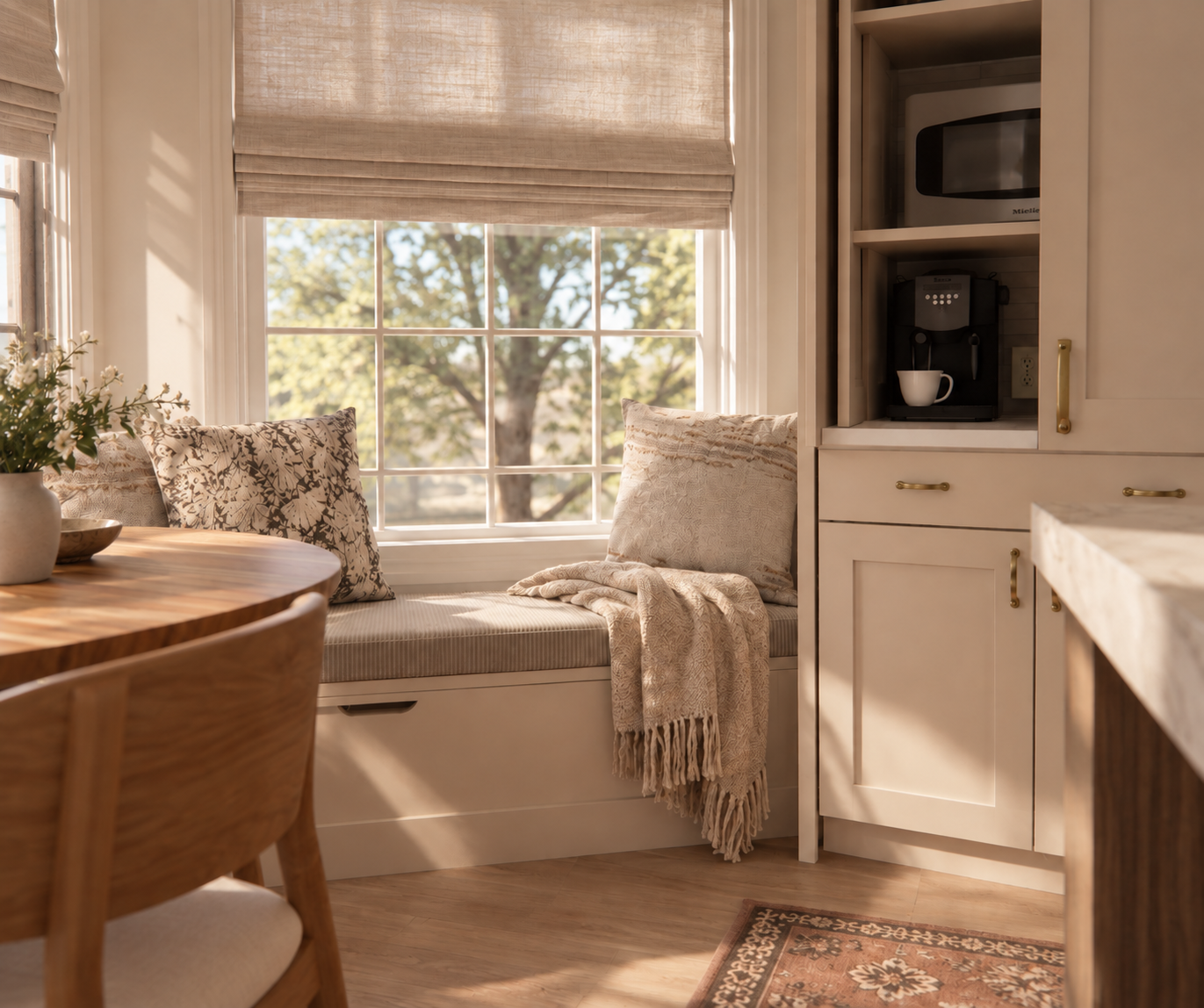
Verona Residence, Wisconsin, Breakfast Nook. Design by Hasti Mirkia, The SoulSpace Design. 3D rendering of the proposed interior.
Exploring prospect and refuge in the Verona Residence
I recently finished the design phase of a residential project in Verona, Wisconsin. As I was putting together the final package, I found myself thinking about one idea that quietly shaped several of my decisions throughout the project: prospect and refuge.
I have known this idea for years through design research, but there is something especially exciting about seeing knowledge that has lived in books, papers, and classrooms find its way into a real home. The idea itself is fairly simple.
Prospect is the ability to look outward. Refuge is the feeling of being somewhat protected or enclosed while doing so.
The concept originated with geographer Jay Appleton's work on landscape preference in the 1970s and was later brought into conversations about architecture and interior space. Researchers have since explored how qualities such as outlook, enclosure, light, spatial transition, and width may relate to our experience of interiors. The findings are not a simple formula, nor should design ever be one, but the relationship between openness and enclosure remains a fascinating way to think about how a space feels.
Bringing the idea into a home
In the Verona Residence, I wasn't interested in creating rooms that simply looked open.
I wanted to think about where someone would naturally want to be within that openness.
The kitchen became an interesting place to explore this. It needed to function as an active family space, with clear views and easy connection across the room. But within that larger environment, the breakfast nook offered something different: a more intimate place to sit, while remaining visually connected to the surrounding space.
That contrast mattered to me.
You can be part of what is happening in the room without necessarily feeling as though you are sitting in the middle of it.
That is where I find prospect and refuge particularly useful, not as a rule, but as a way of asking better questions.
Where does your eye travel when you sit down?
Do you feel exposed or settled?
Can a large room contain a smaller moment?
Can you see what is happening around you while still feeling that the place where you are sitting belongs to you?
These are small questions, but they can change the experience of a room.
Research as part of the design process
One of the things I love most about returning fully to practice is being able to bring together two parts of my life that once felt quite separate: research and design.
My years studying interior environments taught me to look beyond what a room looks like and become curious about what it asks of us psychologically: where we pause, what we notice, what we remember, and where we instinctively choose to sit.
Now, working on homes, I get to ask those same questions in a much more tangible way.
Not every design decision needs a theory behind it. And research should never become a recipe for making people feel a certain way. Homes are far too personal for that.
But research can make us more attentive.
It can remind us that a floor plan is not simply an arrangement of walls and furniture. It is also an arrangement of experiences: moments of openness and enclosure, movement and pause, connection and privacy.
Finishing the Verona Residence reminded me how exciting it is to bring that knowledge into the work I am doing now.
For me, that is where research becomes most meaningful, not when it tells us what a home should be, but when it helps us ask more thoughtful questions about the people who will live there.
References
Appleton, J. (1975). The Experience of Landscape. John Wiley & Sons.
Stamps, A. E. III. (2006). Interior prospect and refuge. Perceptual and Motor Skills, 103(3), 643–653.
Dosen, A. S., & Ostwald, M. J. (2013). Methodological characteristics of research testing prospect–refuge theory: A comparative analysis. Architectural Science Review, 56(3), 232–241. Taylor & Francis Online