

What E-Design Actually Looks Like
June 2026
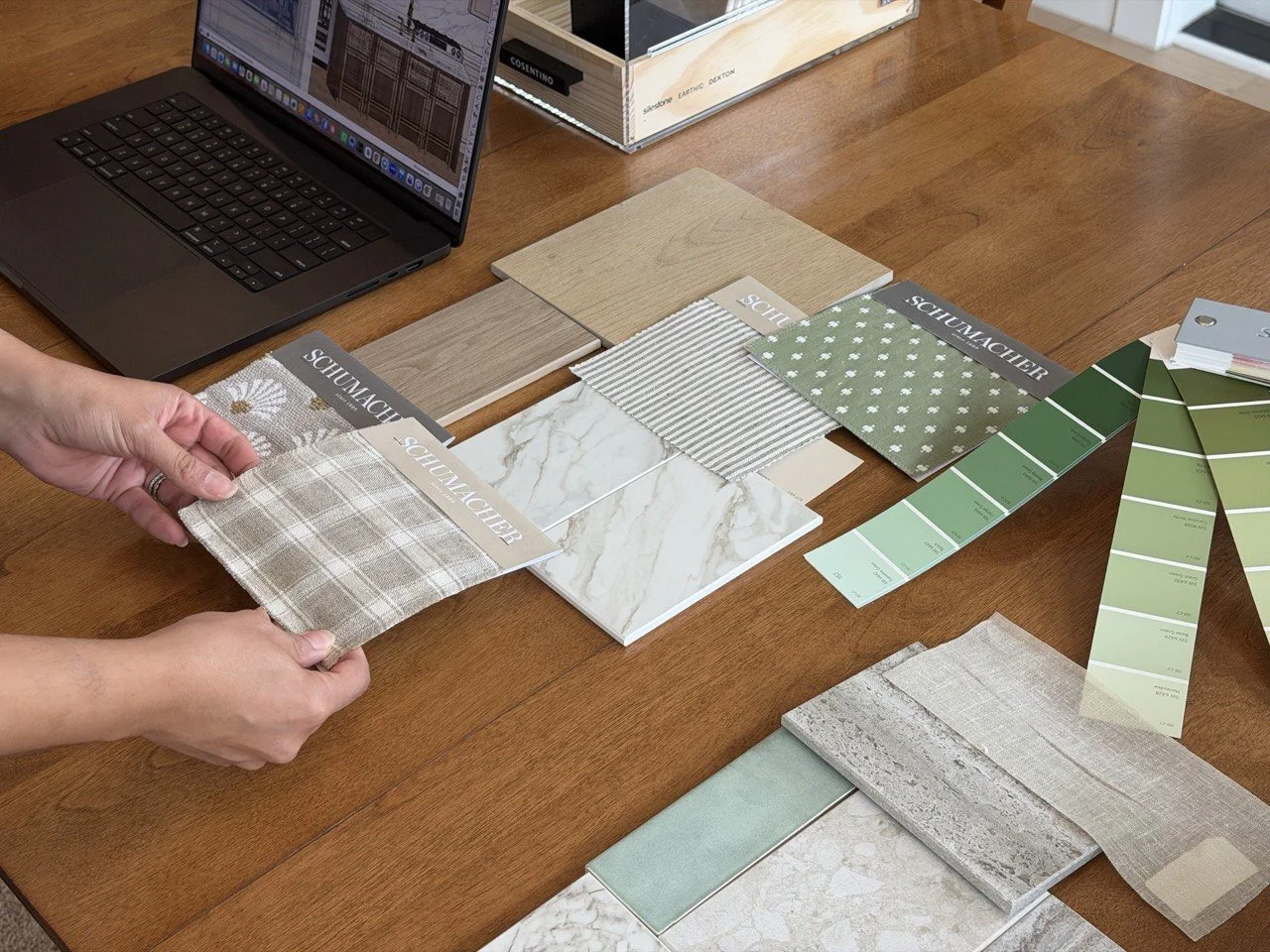
The question comes up early, usually with a little hesitation. How can you design my home if you are not standing in it?
It is a fair question, and I never wave it away. Designing a space from a distance can sound like ordering a custom suit by mail. So I want to take the mystery out of it, because the truth is that e-design, done well, is not a lesser way of working with a designer. It is a more deliberate one. When you cannot rely on simply being in a room, you have to make everything explicit. Nothing is left to a passing glance or a decision made in the moment. Every choice is studied, drawn, and confirmed.
Here is what the process actually looks like.
It begins the way every project of mine begins, with listening. Before a single measurement, there is a long conversation and a detailed questionnaire about how you live. What your mornings sound like. Where you gather. What you have quietly tolerated in a home that no longer fits you. How you want to feel in each room. I have written before that this listening is not the soft part of the work but the most rigorous part, and that is even more true at a distance. The conversation is where I learn the things a tape measure can never tell me.
Then I get to know the space itself. You become my eyes, guided closely: photographs from specific angles, a slow video walkthrough, and precise measurements we take together, often over a video call so I can point to exactly what I need. From those measurements I build a true-to-scale model of your rooms in three dimensions. This is the part that surprises people most. Long before anything is ordered or built, you can see your own kitchen or bath rendered to the inch, move through it on screen, and understand the design in three dimensions rather than imagining it from a flat drawing.
From there, the design develops the way it would in any thoughtful practice, only more visibly. I work in floor plans, elevations, and 3D views, and I usually present more than one option, so you can weigh the trade-offs for yourself rather than taking my word for them. We meet over video, I share my screen, and we move through the design together. You are never handed a finished product to approve or reject. You watch it take shape, and you shape it with me.
The piece people worry about most is material. How can you choose stone, or wood, or paint, without touching them? You do not. I send real samples to your home so you can hold them, set them against your own cabinets, and see them in your own light at six in the morning and again at dusk. A color that looks right in a showroom often looks wrong in your kitchen, and the only way to know is to live with it for a few days in the place where it will actually live. Much of what I believe about material honesty, that your body registers a real material even when your mind does not, depends on this step. So we do not skip it.
When the design is set, I prepare the documents that make it real: detailed drawings, specifications, and selections, all clearly organized so that anyone building from them knows exactly what is intended. I coordinate directly with your contractor, whoever you choose and trust, walking them through the details and answering their questions so nothing gets lost in translation. The documents are built to stand in for me on site, and I stay reachable throughout construction for the decisions that always come up.
What I have come to believe is that good design has never really depended on the designer being physically present. It depends on attention, on a rigorous process, and on making invisible thinking visible. E-design simply makes all of that explicit. You see the model before it is built. You hold the materials before they are ordered. You watch every decision rather than receiving it. If anything, you have more say over your home this way, not less.
A home does not become what you need it to be because someone stood in it once. It becomes that through careful listening, honest materials, and a process you can see and trust at every step. That, quite simply, is what e-design actually looks like.
If you have been wondering whether designing your home from a distance could truly work, I would love to hear about your space.
This reflection is part of the SoulSpace Journal, a space for design thinking shaped by research and lived experience.